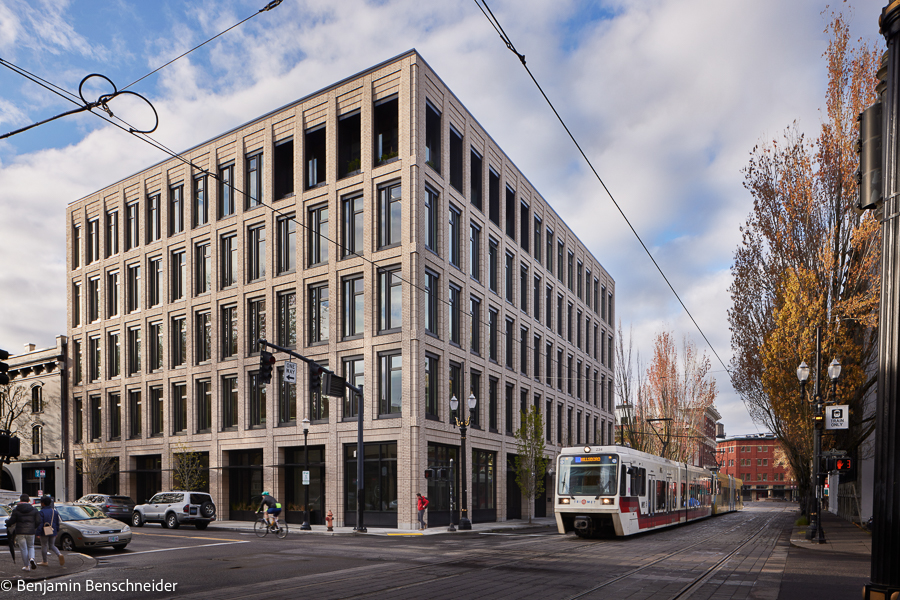
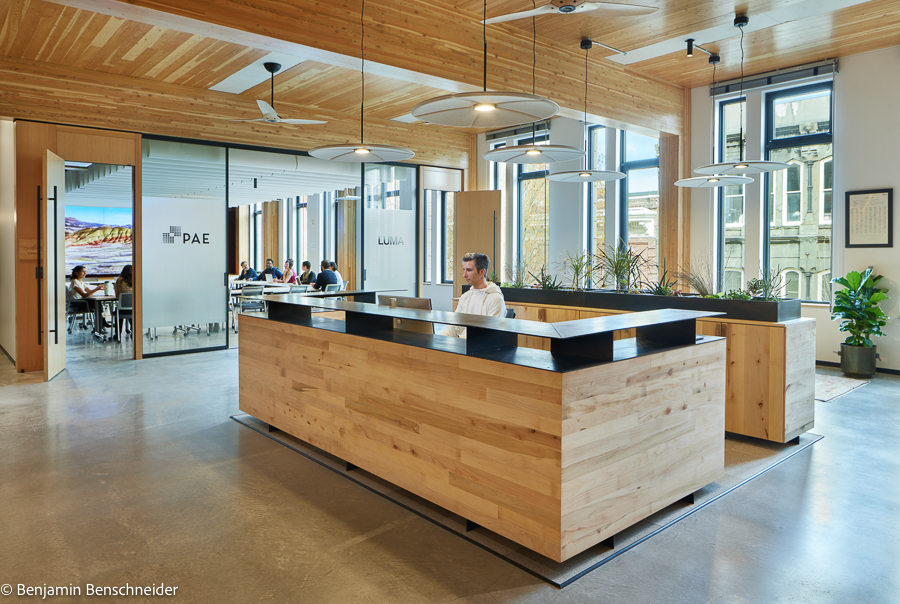
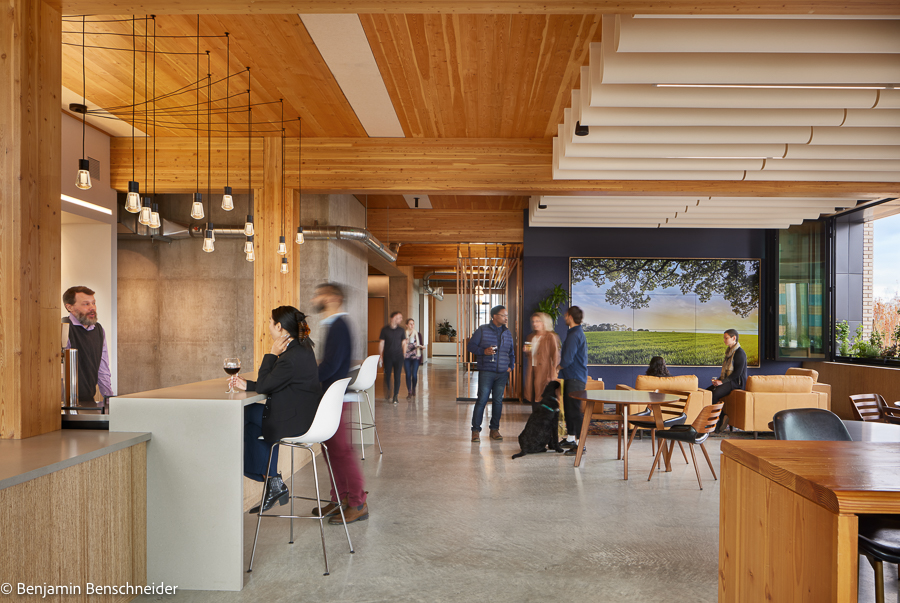
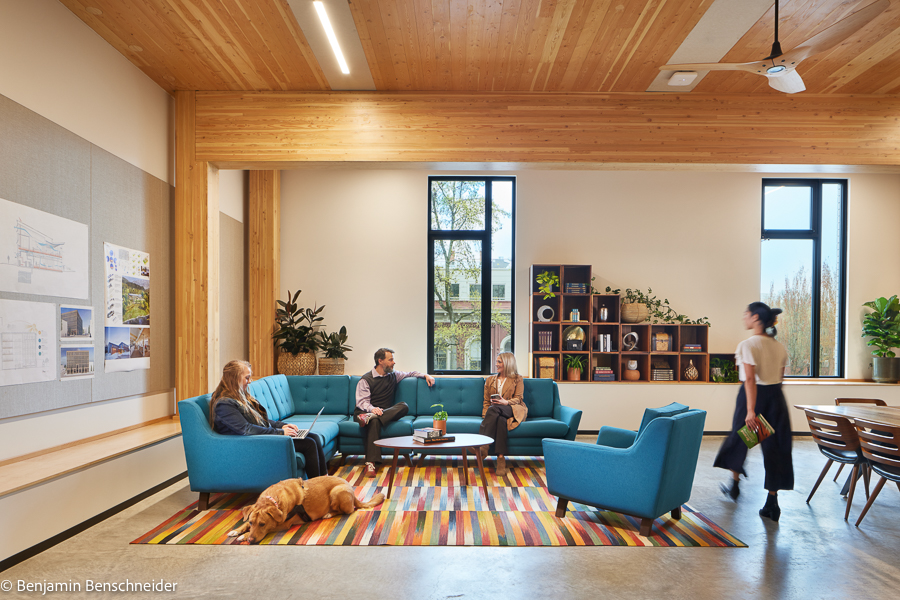
The PAE Living Building in Portland, Oregon, is the first developer-driven commercial Living Building, highlighting the possibilities of sustainable building design.
Yet it also sits in the middle of Portland’s Old Town Historic District, home to some of the oldest buildings in Oregon.
This blend of old and new was what made the project especially exciting to work on for signatory contractor B&B Tile and Masonry Corporation.
“It’s fun when you can make something look old world with new techniques,” said Nathan Storey, B&B owner and CEO.
Storey said the project featured a little bit of every type of brick and block– 72,240 bricks of various sizes and 5,010 CMU blocks, to be exact.
“Technically, it all looks like one type of brick, but we have structural brick, brick veneer, pre-made headers with brick veneer, and thin brick, to make all that brick look like it’s hand laid. And then CMU on the inside,” he said.
Designed to last 500 years, the building’s sustainability stats are impressive. It boasts a 61% energy savings over a typical office complex and generates 113% of its energy needs through a combination of onsite and offsite solar, meaning it’s a net energy producer.
Onsite batteries allow the building to operate off-grid for up to 100 days, and a 71,000-gallon underground cistern captures and treats all the water the building uses. The restrooms feature vacuum-flush composting toilets that use 90% less water than conventional toilets.
Plus, the building is designed to withstand Category IV earthquakes, setting a new precedent for this type of facility. Retail shops comprise the first floor of the 5-story building, with office space on the other 4 floors.
“Its aesthetic appeal and sustainability approach are rooted in simplicity, with a design that showcases how high-performance design can positively impact people and planet,” said Justin Brooks, Principal at ZGF Architects, the firm that designed the building.
Brooks said the firm worked in tandem with Portland’s Historic Commission and Old Town Historic Community Association throughout the entire design, making close collaboration with B&B critical.
“Because the project was required to respond to detailed district regulations addressing aesthetics and material selection, the design team worked very closely with our masonry partners to ensure the façade responded to the style and scale of the surrounding structures,” he said.
To satisfy the Historic Commission’s requirements, B&B constructed a brick soffit on the bottom floor to hide wood framing and ledger irons, and with guidance from the International Masonry Institute (IMI), structural brick headers to hide angle irons from view.
“That was part of the bigger help from IMI, was coming up with a nice structural detail for those headers. We built them all on the ground and put rebar in them, solid grout in them, and then flew them up into place every time we were at that level, kind of all pre-built,” Storey said.
Those types of challenges are the best part about working on projects like the PAE building, he said.
“You’re learning, you’re trying to problem solve, you’re doing a lot in pre-construction,” Storey said. “The challenging stuff is kind of our niche.”